Apartment Moving Checklist: An 8-Week Timeline for Renters

Start about eight weeks before your move. Give notice and book movers first. Three to four weeks out, change your address with USPS and set up utilities and renters insurance at your new place. Finish with a documented move-out walkthrough to support your security deposit refund.
Reviewed 10/23/26 by Dan. This article is general information, not legal advice.
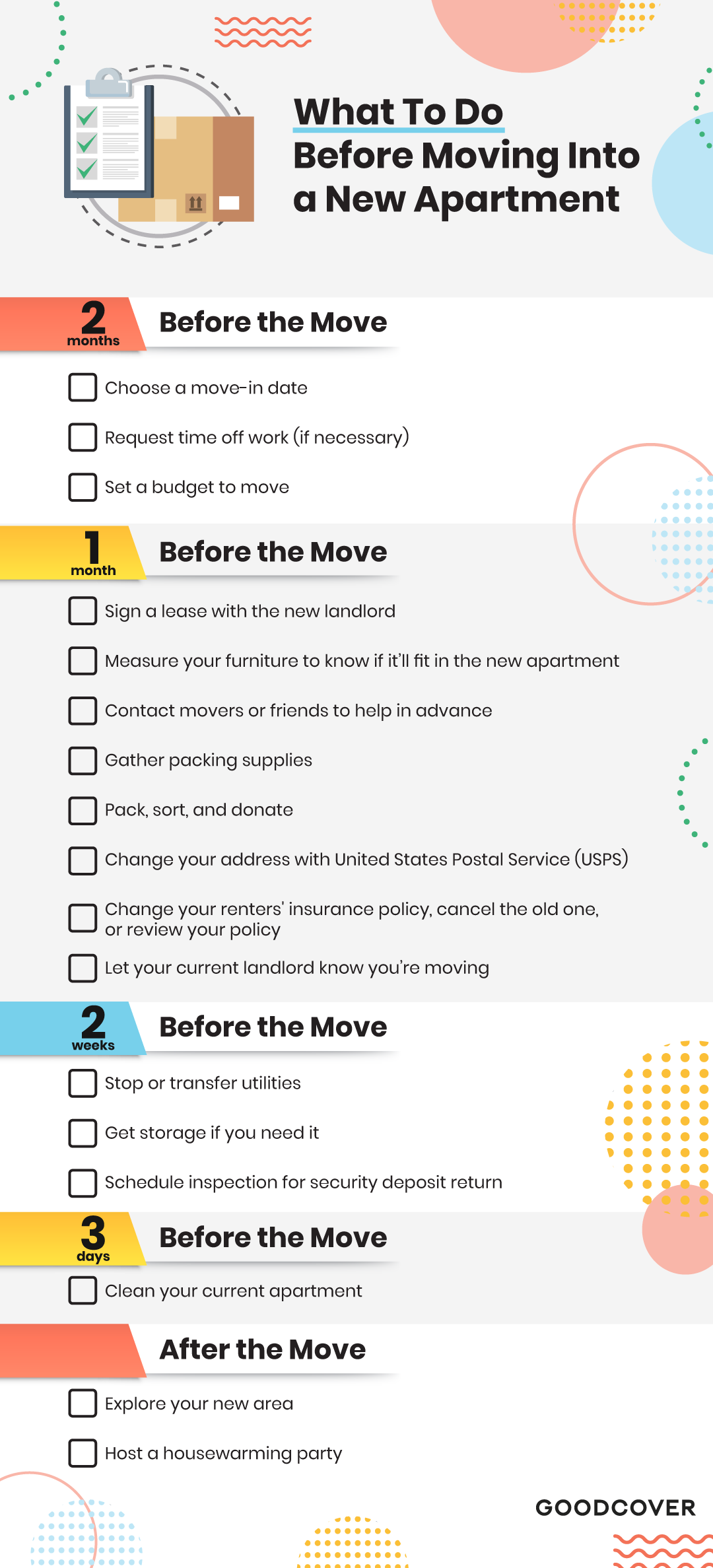
Apartment moving timeline at a glance
When | What to do |
|---|---|
8 weeks before | Read your lease's move-out rules, give written notice, set a budget, get mover quotes, start decluttering |
4 weeks before | Book movers or a truck, file your USPS change of address, schedule utilities and internet, update your renters insurance, ask about the move-out inspection |
2 weeks before | Pack what you don't use daily, photograph valuables, confirm movers in writing, update your address with banks and your employer |
Moving week | Pack a first-night box, clean, do the move-out walkthrough, return keys, give your forwarding address in writing |
After you move | Document the new apartment's condition, confirm mail forwarding, track your deposit refund |
What should you do 8 weeks before moving?
- Read your lease. Find how much notice you have to give, any cleaning requirements, and how the move-out inspection works.
- Give written notice. Follow the deadline and delivery method your lease and local law require. Use email only if it is an accepted method, and keep a copy and proof of delivery.
- Set a budget. Include movers or a truck, packing supplies, deposits at the new place, cleaning and a cushion for surprises.
- Get mover quotes. Ask for written estimates from at least two or three companies. For an out-of-state move, look up the mover's USDOT number in the Federal Motor Carrier Safety Administration's mover database before you book.
- Declutter. Sell, donate or toss what you won't use. Fewer boxes means a cheaper, faster move.
- Measure. Check that big furniture fits through the new place's doors, stairs and elevator.
What should you do 4 weeks before moving?
- Book your movers or truck. Popular dates go quickly, so don't wait.
- Change your address with USPS. File online at USPS.com or at a Post Office. Online requests carry a $1.25 identity verification fee. Allow 7 to 10 business days after approval for forwarding to start. Standard forwarding lasts 12 months.
- Schedule utilities. Set a stop date for electricity, gas, water and internet at your old place, and a start date at the new one. Book internet installation early, since appointments can take a while.
- Update your renters insurance. Set your new address to take effect on your move date. See the section on renters insurance below.
- Ask about the move-out inspection. Find out when your landlord will inspect and whether you can be there. In California, you can request an initial inspection, which takes place no earlier than two weeks before the tenancy ends. That gives you time to address identified issues before leaving (Cal. Civ. Code § 1950.5(f)).
- Reserve the building. Ask both buildings about elevator reservations, loading docks and moving hours.
- Arrange storage if there's a gap between leases. Read how renters insurance covers a storage unit before you fill one.
What should you do 2 weeks before moving?
- Pack the non-essentials. Label each box with its room and contents.
- Photograph your valuables before you pack them. A home inventory with photos and serial numbers makes any claim easier.
- Confirm your movers in writing. Get the date, arrival window, price and what's included.
- Check your mover's liability options. For an interstate move, Full Value Protection is the default unless you expressly waive it. The Released Value option comes at no additional charge but limits the mover's liability to 60 cents per pound per item, so a lost 10-pound item worth $1,000 would have a $6 liability limit (Surface Transportation Board, FMCSA). These are mover valuation options, not a separate insurance policy; moves within one state follow that state's rules.
- Update your address with everyone else. USPS only forwards mail. Tell your bank, credit cards, employer, insurers, doctors, subscriptions, the DMV and your voter registration office yourself.
- Refill prescriptions and transfer them to a pharmacy near your new home if you need to.
What should you do on moving week?
- Pack a first-night box. Toilet paper, chargers, medications, toiletries, bedding, a change of clothes, basic tools, trash bags and snacks.
- Keep important things with you. Carry documents, jewelry, laptops and anything irreplaceable instead of loading them on the truck.
- Clean the old apartment. Follow any cleaning requirements in your lease.
- Do the move-out walkthrough. Take dated photos and video of every room once it's empty, including inside appliances and closets. Photograph the final meter readings.
- Return your keys and get a receipt.
- Give your forwarding address in writing. In Texas, your landlord doesn't have to refund your deposit or itemize deductions until you do (Tex. Prop. Code § 92.107).
What should you do after you move?
- Document the new apartment's condition before you unpack. Use our rental inspection checklist, take photos, and send your landlord a list of existing damage.
- Confirm your mail is forwarding and update any account you missed.
- Track your deposit refund. Deadlines and their starting conditions vary by state: California generally allows 21 calendar days after you vacate. Texas generally allows 30 days after you surrender the premises, with the written-forwarding-address requirement noted above. Arizona allows 14 days, excluding Saturdays, Sundays and legal holidays, after termination of the tenancy, delivery of possession and your demand. If deductions look wrong, see our guide to unfair security deposit deductions.
When should you update your renters insurance?
Before moving day. Your policy is written for your current address, so update it to take effect on the day you start moving into the new place. Here's how to change your address on a Goodcover policy.
Goodcover policies cover your belongings at your new home without the away-from-home limit for the first 30 days after you start moving in, which helps if your move takes more than a day.
If you're moving in with roommates, Goodcover's current policies automatically cover roommates who are on the lease. If your new landlord requires renters insurance, ask what proof they need before you get the keys.
Frequently asked questions
How far in advance should I start planning a move?
About eight weeks. That gives you time to give notice, compare movers and book a date. Book movers and file your USPS change of address no later than three to four weeks out.
How much does it cost to change your address with USPS?
Filing online costs $1.25 for identity verification. You can also file at a Post Office with PS Form 3575, which comes in a free Mover's Guide packet. First-Class Mail is forwarded free, and standard forwarding lasts 12 months.
When should I switch my renters insurance to my new apartment?
Set the change to take effect on the day you start moving in. Goodcover policies cover belongings at your new home without the away-from-home limit for the first 30 days after you start moving in.
How do I get my security deposit back?
Leave the apartment clean, document its condition with dated photos, return your keys, and give your landlord your forwarding address in writing. Then watch for the refund or an itemized list of deductions by your state's deadline.
What should I pack in a first-night box?
Toiletries, medications, phone chargers, bedding, a change of clothes, toilet paper, trash bags, basic tools and snacks.
Ready for moving day
A move goes smoother when the deadlines are on a calendar, not in your head. Work through the timeline and protect your belongings from the first box to the last.
Get a Goodcover renters insurance quote
This article is general information, not legal advice. Laws change, and local rules may add protections. Check the current law or talk to a local legal-aid office or attorney about your situation.